

The Worship
Inside my obsession with Sleep Token and why wonder still breaks through the noise.

Obsessions have always orbited around music for me. As a teenager it was Nightwish and Lacuna Coil, their grandiose, gothic worlds giving me something vast to disappear into. Then came Incubus and Placebo, bands that wore fragility on their sleeves in a way that matched my own restlessness. Later it was Deftones, Enter Shikari, everything Björk and Thom Yorke, Run the Jewels and even a full Kanye West phase (the sound mattered more than the man, I promise). Each time, the obsession swallowed me whole. I’d live inside those albums until they rewired something in me.
Then my partner told me about Sleep Token. She said their music was made for me, but I wasn’t convinced.
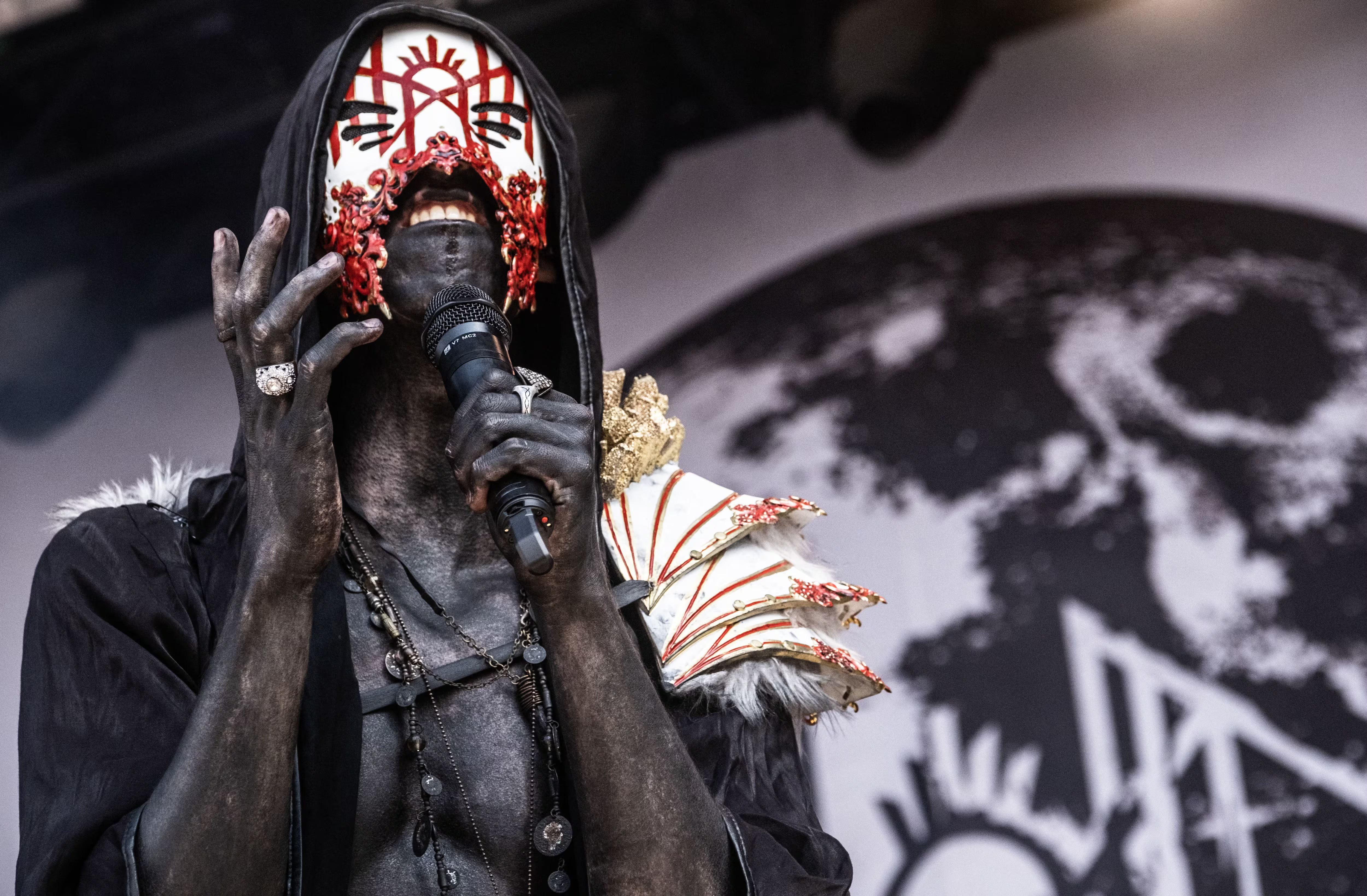
(For the uninitiated: Sleep Token is a masked, anonymous collective led by a figure known only as Vessel. On stage, they don’t perform so much as conduct ritual. Faces hidden, bodies cloaked, every movement deliberate, as if the music itself demands ceremony.)
Everything around the band felt overdesigned, pretentious, another gimmick. I brushed it off. Until one January morning, I pressed play on Alkaline.
And that was all it took.
Hooked isn’t the word. Possessed, maybe. For the past nine months, I’ve barely listened to anything else. Beyond the endless podcasts in my queue, it’s been Sleep Token and almost nothing but.
What keeps me there is not just the music, but the world around it. The way a single song can crush you and cradle you in the same breath. The lyrics don’t seem to just describe emotion but rip it straight out of you. The lore that never explains itself, yet pulls you deeper every time.
I was taken. Engulfed. And I think that’s the point: anonymity isn’t the essence of the band, it’s the final veil. What matters is that the music wounds and consoles, dismantles and transforms. In a world where almost everything has been flattened into content, Sleep Token reminds us our capacity for awe isn’t gone.
The Music (The Core Force)
What really matters is the music. And musically, they’re impossible to pin down. One moment it’s down-tuned riffs that feel like they could tear the floor out from under you; the next, falsetto R&B, fragile piano, or gospel swells. Metal, pop, electronic, ambient, cinematic - it all collides, not as experiment for experiment’s sake, but because this is the truest way they can express what they need to express.
That undefinable sound has carried them far beyond the underground. Take Me Back to Eden charted worldwide in 2023. They’ve sold out arenas at unprecedented speed, climbed to the top of festival bills, and watched The Summoning become a viral phenomenon on TikTok. Critics at NME, Revolver, and beyond hail them as one of the most important new forces in heavy music. In less than a decade, they’ve risen from obscurity to global recognition without ever breaking character.
For me, Sleep Token isn’t about heaviness. It’s about the genius of combining styles in ways that shatter the norms of genre. The weight comes not from distortion alone, but from the way brutality and tenderness coexist - how something violent can collapse into something fragile without losing coherence. It feels less like genre-blending and more like the natural language of genius musicians.
And that’s what makes it consuming. Most music today is designed to be shuffled, clipped, or optimized for algorithms. It seems like Sleep Token refuses that role. These aren’t songs you put on in the background; they demand presence. When a chorus finally breaks open, or when Vessel’s voice cracks on a single line, it doesn’t feel like performance. It feels like something raw escaping—something you’re not supposed to hear, but can’t stop listening to.
The Lyrics (The Confession)
If the music is what crushes and carries you, the lyrics are what cut. Vessel writes like someone whispering a secret at 2 a.m., when 3 bottles of wine have brought all the defenses down. It’s poetry in the truest sense: not as decoration and unnecessary metaphors, but as pure emotion distilled into words.
Take the chorus of Alkaline (surely one of my favorite Sleep Token songs), which shows both the craft and the wound:
“She’s not acid nor alkaline,
Caught between black and white,
Not quite either day or night,
She’s perfectly misaligned.
I’m caught up in her design
And how it connects to mine,
I see in a different light
The objects of my desire.”
It’s a flawless metaphor - chemistry, alignment, light, stitched together into something that feels almost mythological. On the surface, it’s simple - contradiction turned into a love poem. But its genius lies in how the metaphor makes the personal universal. It’s the raw feeling of being undone by someone, of recognizing your entire chemistry has shifted because they exist. Anyone who’s been consumed by desire, by love, by obsession, can hear themselves inside it.
That’s the balance Sleep Token strikes. Sometimes the lyrics cloak the pain in metaphor, making it vast enough to feel sacred. Other times, they strip it down until only the nerve is exposed.
Granite is a great example of that nakedness.
“I was more than just a body in your passenger seat.”
No metaphors, no alegory, no beating around the bush. It’s plain, but devastating. In its simplicity, it says everything about being reduced, discarded, or forgotten.
And then there’s Caramel, where the mask of myth slips entirely.
The song feels like an unmasking, not just of Vessel but of the project itself. If Alkaline is the cosmic metaphor and Granite the blunt wound, Caramel is the moment the myth turns against its maker:
“This stage is a prison, a beautiful nightmare,
A war of attrition, I’ll take what I’m given,
The deepest incisions, I thought I got better,
But maybe I didn’t.”
Here, performance itself becomes suffocating. The imagery of stages and prisons collapses into the real weight of being seen, of building a myth only to realize you’re trapped inside it.
Earlier lines twist the knife even deeper:
“Acting like I’m never stressed out by the hearsay, I guess that’s what I get for trying to hide in the limelight.”
It’s the voice of a person exhausted by their own creation, stripped of armor, terrified by the cost of visibility.
This is where Sleep Token’s lyrical mastery reveals its full shape - the ability to oscillate between the cosmic and the confessional, the universal and the painfully specific. To write a line that sounds like scripture (“She’s perfectly misaligned”), and another that sounds like a late-night journal entry (“I thought I got better, but maybe I didn’t”), and to make both feel like they belong to the same voice.
The Lore (The Myth)
Hovering around the music is a strange, half-spoken mythology. The story goes that Vessel serves an ancient deity called Sleep, hence the name of him being a vessel, offering the songs not as art but as acts of worship. The fans are not positioned as an audience, but as participants in that worship. Songs aren’t “songs”, they’re called offerings. Concerts aren’t “gigs”, they’re rituals. Everything is framed as devotion, as if the band is less a group of musicians and more a conduit for something divine.
What’s striking is how deliberately incomplete it all is. The lore never explains itself fully. There’s no neat canon to memorize, no interviews to break it down. Like, there are almost no interviews at all. Instead, it all lingers at the edges, leaving space for listeners to project their own meaning onto it. That’s what makes it powerful: it doesn’t tell you what to believe; it creates the conditions for belief.
And that’s where the weight comes from. Sleep Token’s myth refuses to resolve into clarity. It doesn’t operate like branding or backstory - it feels more like atmosphere. The lore is not about information; it’s about haunting the audience and completing the experience.
The Anonymity (The Veil)
And hand-in-hand with the lore, there comes the part most people notice first: the masks, the hidden faces, the refusal to be known. Vessel never breaks character. And I mean never. The band never steps out of the myth.
I grew up with Slipknot, so my generation already knew what it feels like to see a band that wore anonymity like armor. Masks, numbers, hidden identities… it wasn’t shocking to me. It wasn’t even novel.
That’s why I was never hooked on Sleep Token because of the anonymity. I didn’t need that angle to be convinced. If anything, I was wary of it at first, afraid it would feel like just another recycled shtick. But within Sleep Token it works differently. The anonymity isn’t the point - it’s the veil that protects the point.
By stripping away names and identities, the focus is forced back onto the music, the worship, the offering itself. In a culture obsessed with hypervisibility, where artists are expected to livestream their breakfast, narrate their breakups, and turn their personal lives into content, Sleep Token does the opposite. They disappear. And paradoxically, that disappearance creates presence.
Because in the end, even with all the conspiracies and internet sleuths what matters isn’t who Sleep Token are. What matters is what happens to you in the act of listening. The veil is acutally an invitation to step into something larger than personality. Something sacred.
Why It Matters
Obsession is usually solitary, but not always. Taylor Swift has her Swifties. Justin Bieber had his Beliebers. Every pop star now comes with a ready-made army of fans, branded and organized like a franchise. These fandoms create community, yes, but more often they feel like extensions of the marketing machine: a way to turn devotion into clicks, streams, and merch sales.
I feel like that’s the state of the modern music industry. Pop stars, bands, even entire genres get packaged as products, optimized for maximum engagement. Songs are designed to fit playlists. Identities are polished until they’re brand assets. Fans are target markets dressed up as “communities.” In this world, music becomes less about transcendence, more about consumption. A fandom becomes another product you can belong to.
And yet here is a band that refuses all of that. A band that asks for surrender instead of casual listening. That treats devotion as central. That leaves space for mystery in a world obsessed with explanation.
That’s why, in my opinion, Sleep Token matters. Not because of the masks, not even because of the myth, but because they’ve managed to create a space where awe is still possible. A space where you can be broken open and remade, not by spectacle, but by sound and confession.
And maybe that’s what keeps me so hooked. Because if music can still feel sacred - if it can still wound, console, and transform, then maybe we haven’t lost our capacity for wonder after all.
Epilogue
I’ve spent nine months living almost entirely inside Sleep Token’s world, and I still don’t feel finished. That’s what obsession does. It shows you who you are by consuming you.
But beyond my own fixation, what stays with me is the reminder that the sacred isn’t gone. It’s easy to believe we’ve lost it, that everything has been reduced to content and commentary, that awe has no place in an algorithmic world. And then something comes along - something unexpected, something overwhelming that proves we’re still capable of being undone.
That’s what Sleep Token is for me: proof that wonder hasn’t disappeared. It’s just waiting, hidden behind a veil, waiting for us to listen closely enough to be transformed.
Nicely done! They hit me hard, too. I jumped on when Take Me Back To Eden was released and have been riding the wave ever since. Thanks for posting this.
I’ve been making notes for months about a post I wanted to write about this unexpected and remarkable span in my life that’s come to be defined by this band, and the parts of me that are back online — because I heard them and they remade me, they altered the way I see the world and myself.
And then I read this and realized it had already been written.