

Emotional Entropy
Why melancholy feels like wholeness

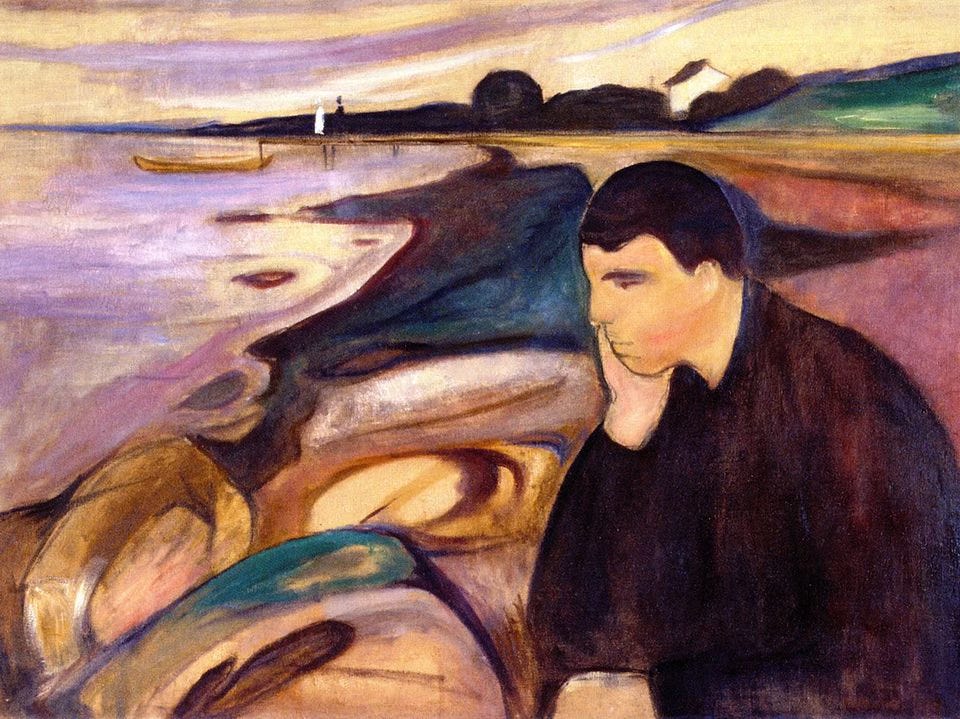
“Melancholy”, Edvard Munch, 1891
There is music that bypasses the category of “music” entirely. When I listen to it, I don’t experience it as composition or production. It behaves more like a physical force. It moves through the body with density and pressure. Something inside expands until I become sharply aware of the limits of my own skin, as if my emotional capacity briefly exceeds the container that holds it.
Björk’s Pagan Poetry has that quality. The song unfolds with geological intensity. The voice trembles and rises from somewhere that feels pre-verbal, carrying devotion, vulnerability, erotic tension, and something almost sacred in scale. The experience feels elemental, closer to weather or tectonic movement than to entertainment.
When the surge passes, what remains is a state I can only describe as melancholy. The word usually carries associations of nostalgia or softness, but the feeling here is structured and whole. There is fullness in it. Emotional currents that had gathered around specific points begin to circulate more evenly. The system feels recalibrated.
The closest metaphor I have is rather physical. In thermodynamics, entropy describes the redistribution of energy within a system. Differences in pressure gradually equalize. Concentrated intensity spreads until equilibrium is reached.
Melancholy is emotional entropy.
Intense feelings that were sharply directional dissolve into a wider field of awareness. Nothing disappears; it reorganizes. Anger, longing, beauty, memory, love, the awareness of time - they coexist without competing for dominance. The gradients soften and emotional energy circulates rather than concentrates.
Most emotions operate through direction and focus. They push the system toward something or away from something. Melancholy feels like the settling of those movements. The psyche holds magnitude without straining against it.
Music becomes a contained way of entering that process. A song like Pagan Poetry expands the interior space first, amplifying emotional intensity until it brushes against overwhelm. As the sound recedes, the psyche reorganizes around a broader equilibrium. The result feels centered, spacious, proportionate.
In a culture oriented toward peaks (outrage, excitement, acceleration) this kind of equilibrium can feel unfamiliar. Perception deepens and time feels tangible.
Melancholy often is associated with depression. But depression narrows emotional range. The melancholy I am describing widens it. It allows contradictory elements to exist within the same field of experience. It metabolizes magnitude into balance.
When emotional energy redistributes across the system in this way, the result feels profoundly human. It carries awareness of finitude, beauty, fragility, and continuity at once.
Melancholy, understood as emotional entropy, becomes a regulatory process rather than a deficit. A way of absorbing what would otherwise feel too large to hold. And in that absorption, there is a quiet form of bliss rooted in proportion rather than intensity.
Some songs expand us beyond our physical containers. Some experiences do the same. The body feels too small. And afterward, something settles into place with unexpected coherence.
If you’ve felt that quiet recalibration — after music, after awe, after grief, after love — you’ve probably touched the same state. And if you have, I welcome you as a kindred soul.